
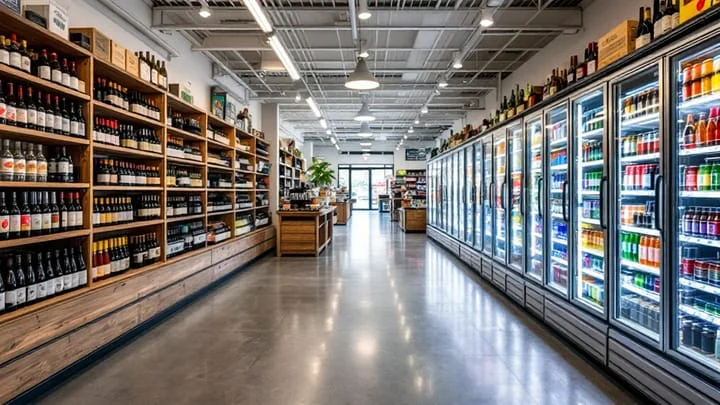
Encinitas · Type 20
Encinitas Type 20 Liquor License For Sale
Encinitas, CA
Type 20
Off-Sale Beer and Wine
New Type 20 licenses remain open to Encinitas stores: a retailer may apply to ABC for a fresh one or take over an existing license by transfer. ABC's 2023 moratorium figures give the city and San Diego County a "No" each, so the moratorium for places with over one Type 20 per 2,500 residents does not apply here while those lists stand. ABC's drawings FAQ adds that qualified applicants can obtain beer and wine licenses year-round. ABC's export updated November 10, 2026 counts 21 active Type 20s in Encinitas and 834 countywide.
Supply here
What ABC's records show for this class
Encinitas holds 21 active Type 20 licenses out of San Diego County's 834, or roughly one in every 40 in the county. Both figures come from ABC's Daily Data Export in the edition ABC updated on November 10, 2026, which was retrieved that day.
Type 20 issuance in Encinitas runs without a quota; what can stop new licenses of this class is a moratorium, explained in ABC's 2023 Type 20 moratorium figures: Section 23817.5, as amended on January 1, 1998, permanently halts new off-sale beer and wine licenses in a city or county where Type 20 licenses run above one for each 2,500 inhabitants.
On ABC's lists, Encinitas is not under that moratorium. The city table pairs Encinitas with San Diego County and enters "No" under Moratorium, and the county table enters "No" for San Diego as well. ABC made these lists effective January 1, 2023 and says they stand until recalculated in approximately five years, under Section 23817.9; the report was retrieved November 10, 2026.
ABC sets no filing season for this class: its FAQ on priority registration drawings, retrieved the same day, tells qualified applicants that beer and wine licenses can be had at any point in the year. Alongside a new application, a store can still take over an existing Type 20 by transfer; ABC's Transfer or Change a License page (retrieved November 15, 2026) describes a person to person transfer as moving an existing license to a new owner.
Last checked November 10, 2026.
Class rules are confirmed for your specific premises during qualification, and nothing on this page is legal advice.
Local rules
City rules for beer and wine sold to go
The rules below are the City of Encinitas's own and apply within city limits.
Zones where off-site sales are allowed
- Section 30.09.010, the citywide Zoning Use Matrix, sorts each land use, zone by zone, into allowed by right, allowed with a use permit, or prohibited, and sends readers to each specific plan's own list of allowed uses (Chapter 30.84). It is cited here as of March 24, 2025, in the version attached to the August 13, 2025 Council report, Item 10A (retrieved November 11, 2026). Among those plans are Downtown Encinitas, North 101 Corridor, Cardiff-by-the-Sea and Encinitas Ranch; for a site inside one, the section points to that plan's list.
- In the matrix as of March 2025, the row for off-premises alcohol sales shows P (permitted by right) under GC and Cm (minor conditional use permit) under L-VSC, Limited Visitor Serving Commercial. Every other column except VSC shows X, prohibited: the five columns from RR through R-30 OL, then MHP, OP, LC, LI, BP, P/SP, ER/OS/PK and LLC (Section 30.09.010, as of March 24, 2025, retrieved November 11, 2026).
- Two City documents from 2025 differ on VSC (Visitor Serving Commercial). The matrix as of March 2025 marks it P, but the April 17, 2025 Planning Commission staff report in the same packet (retrieved November 11, 2026) says off-premises sales there may be authorized through a minor use permit.
Convenience stores in the L-LC zone
- A 2025 case asked whether a convenience store in the Limited Local Commercial (L-LC) zone could add beer and wine to go. In Resolution PC 2025-11, adopted April 17, 2025, the Planning Commission found that off-premises alcohol sales are a prohibited use in that zone and not an allowable accessory use there, and that no code provision allows a conditional use permit for them as an accessory use in L-LC. The resolution is a use interpretation, not a code section. It is reprinted in the August 13, 2025 Council report (Item 10A, retrieved November 11, 2026), which dealt with an appeal in that case.
- In the same report, City staff wrote that EMC 30.48.030, the section listing the accessory uses permitted in commercial zones, does not include alcohol sales and gives no interpretations or exceptions (retrieved November 11, 2026).
Public convenience or necessity findings
- Where an application needs a local finding of public convenience or necessity (PCN) and the license type falls to the City, the City has 90 days from ABC's notice of the application to decide. City staff set this out in a February 16, 2017 Planning Commission report, reprinted in the April 19, 2017 Council report (Item 10A, Part 1, retrieved November 11, 2026), and named Types 20 and 21 among the license types the City commonly makes PCN findings for. The same report ties the need for a PCN finding to Business and Professions Code Section 23958.4, the state rule on areas with an undue concentration of alcohol establishments.
- City Council Resolution 96-37, adopted May 15, 1996, gives these reviews to the City Manager or a designee, and a determination can be appealed to the City Council under Municipal Code Chapter 1.12 (retrieved November 11, 2026).
- Its public convenience standard asks the applicant to show that the premises are meant to offer goods or services apart from alcohol, with alcohol bought as a secondary item; data showing that food or other merchandise fills most of the floor space is one example of the evidence it names (Section B.1 of Resolution 96-37, retrieved November 11, 2026).
- Its necessity standard asks for evidence of substantial public demand for the product that would go unmet without the permit, such as data showing the premises would offer a unique experience not otherwise found in the City of Encinitas (Section B.2, retrieved November 11, 2026).
- The resolution is given here as of February 16, 2017, the date of the staff report that describes it as in effect (April 19, 2017 Council report, retrieved November 11, 2026).
Responsible beverage training (Chapter 9.43)
- Chapter 9.43, added by Ordinance 2009-13 on December 9, 2009 (retrieved November 11, 2026), applies to every alcohol outlet, defined as any location where alcohol may be sold, delivered or served at retail under an ABC license, which takes in a Type 20 store. An outlet may not sell, serve or arrange delivery of alcohol to a patron unless a manager, assistant manager or lead employee who has completed Responsible Beverage Service and Sales (RBSS) training is on the premises.
- The licensee and every manager and server also need RBSS training of their own before selling, serving or delivering alcohol, with 90 days allowed from the date they start that work, or from the chapter's effective date if later (9.43.020(b), retrieved November 11, 2026).
- A certificate stays valid for two years. Licensees must make sure their managers and servers comply, and must keep proof of everyone's training on the premises for any peace officer or other enforcement officer to inspect during regular business hours (9.43.020(c) to (e), retrieved November 11, 2026).
- A violation is an infraction punishable under EMC 1.08.050, and the prosecutor may choose to charge it as a misdemeanor (9.43.030(a), retrieved November 11, 2026).
- These points give Chapter 9.43 as adopted in 2009 (retrieved November 11, 2026); a May 10, 2017 Council agenda lists the introduction of Ordinance 2017-06 to amend the chapter's definition of RBSS training.
Questions
Site questions that depend on the city
Which Encinitas zones let a store sell beer and wine to go without a use permit?
GC, going by the citywide matrix as of March 2025. That version also marks VSC as permitted by right, but a 2025 staff report in the same packet describes a minor use permit there. L-VSC needs a minor conditional use permit, the matrix's other columns prohibit the use, and a site within a specific plan, such as Downtown Encinitas or Cardiff-by-the-Sea, depends on that plan's own list.
Can a convenience store in the Limited Local Commercial zone start selling beer and wine?
Not on the Planning Commission's April 2025 reading. Its Resolution PC 2025-11 treats off-premises alcohol sales in L-LC as a prohibited use that is not allowed as an accessory use either, and it found no code path to a conditional use permit for that accessory use. An appeal in that case was on the City Council's August 13, 2025 agenda.
Does the City weigh in on a new Type 20 application?
It can. When an application needs a public convenience or necessity finding and the decision falls to the City, staff wrote in 2017 that Encinitas has 90 days from ABC's notice, with Types 20 and 21 among the usual cases. Resolution 96-37, which the 2017 report treats as in effect, gives the review to the City Manager or a designee and sets one standard on alcohol being a secondary purchase and another on demand that would otherwise go unmet; the decision can be appealed to the City Council.
Class basics
What a Type 20 allows
Under a Type 20 (Off-Sale Beer and Wine), a store's customers take what they buy away to drink elsewhere: beer leaves in containers, wine in packages capped at 52 gallons per sale, and every buyer must be a consumer rather than a reseller. Distilled spirits are not part of the license, and ABC's wording allows minors on the premises.
For how the class works statewide, read the California Type 20 license guide.
Selling spirits to go, or pouring drinks on site, calls for another class; these have their own Encinitas pages:
Who you are dealing with
The desk behind the book
Broker
Liquor License Agents
Escrow held by
A licensed escrow holder
Tell us what you need
Start with the site's address
Because the citywide matrix, as of March 2025, permits off-site sales by right in GC and prohibits them in most other zone columns, start with the site's address, on the form or by phone at (800) 799-9081.
Or call the desk on (800) 799-9081.